The Crop Report 1
Q3 2025: Taxes and Inflation - "You Reap What You Sow"
We recently announced the launch of Harvester Insights and are excited to share the first edition of The Crop Report. This quarterly report offers a forward-looking, in-depth analysis of timely financial and investment topics. The first edition examines the harmful effects of taxes and inflation on wealth and presents two planning strategies and one investment solution for your consideration.
We will discuss Roth IRA conversion strategies, a relevant topic for those concerned that income tax rates may rise to pay for the growing U.S. debt. Next, we introduce Protective Strategies to help you protect your wealth during periods of acute distress, such as a 25% equity correction or a recession, and during long-term adversity like the stagflation period from 1965 to the early 1980s. Finally, we highlight the potential benefits of including Treasury Inflation-Protected Securities (TIPS) in your Protective Strategies—what they are, how they work, and how they can support essential spending needs in retirement.
The Crop Report’s objective is to deliver strategic investment insights as seeds for your financial future, helping you cultivate a more abundant life, for "you reap what you sow."
Roth IRA Conversions: A Tax- Smart Strategy to Consider
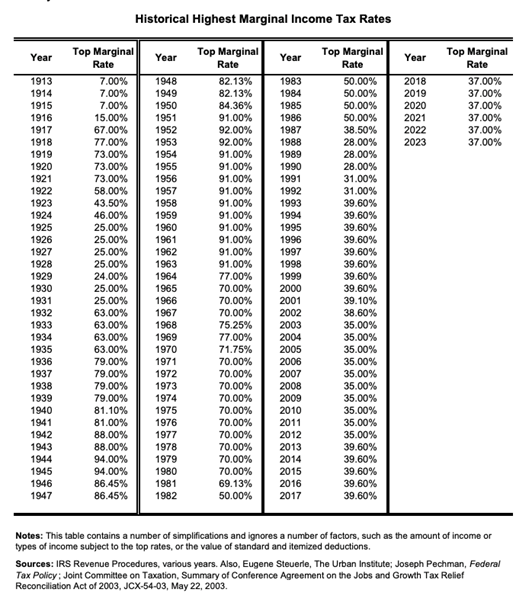
As the U.S. national debt reaches $37 trillion, urgent fiscal strategies are emerging. The government may cut entitlements, raise taxes, or seek lower interest rates to reduce borrowing costs. With $18.9 trillion in U.S. tax-deferred accounts, a 20% average tax rate could generate $3.8 trillion in future IRS revenue. Raising income tax rates could further impact tax-deferred retirement accounts, leading to a wealth transfer from private individuals to the government and potentially eroding retirees' savings.
Paying taxes now on some retirement assets through Roth IRA conversions might be beneficial. These conversions provide tax-free growth, eliminate required minimum distributions (RMDs), and allow tax-free withdrawals for beneficiaries. For inherited Roth IRAs, beneficiaries must liquidate within 10 years under the SECURE Act, but withdrawals stay tax-free if conditions are met, improving estate planning.
How Does It Work?
A Roth IRA conversion involves moving funds from a traditional IRA or 401(k), where contributions grow tax-deferred, to a Roth IRA. You pay income tax on the converted amount in the year of conversion, but qualified withdrawals in retirement are tax-free. Converting now can help hedge against a future increase in tax rates, taking advantage of today’s relatively lower income tax rates.
Is a Roth IRA Conversion Right for You?
Whether a Roth conversion makes sense depends on your tax situation, income, and long-term goals. Key advantages come when you’re in a lower tax bracket.
Smart times to consider converting:
- During early retirement or low-income years (e.g., sabbatical or job loss)
- When markets are down and asset values are temporarily low
- If you expect higher income or tax rates in the future (from RMDs or legislation)
Other benefits:
- Paying taxes with non-IRA funds lets the full balance grow tax-free
- Roth IRAs create tax-free inheritance—ideal for heirs in high tax brackets
- Even at a 37% tax rate, converting undervalued assets can be worthwhile
- Helps maintain long-term tax control and flexibility
A Hypothetical Roth Conversion Scenario
Consider a hypothetical 60-year-old retired couple filing jointly with a $1,000,000 IRA Rollover and $238,000 annual retirement income.
- After $30,000 standard deduction → $208,000 taxable income
- In 2025, the top of the 24% bracket is $383,900
→ $175,900 of “room” to convert to Roth without entering a higher bracket.
Why Convert $175,900/year?
- Lowers future Required Minimum Distributions (RMDs)
- Helps control taxable income in retirement
- May reduce Medicare premiums
- Moves assets into a tax-free Roth account
Long-Term Benefit (by Age 85)
- Traditional IRA: ~$8.2 million (after tax)
- Roth IRA (converted annually): ~$9.1 million (tax-free)
- Net advantage: + $885,000
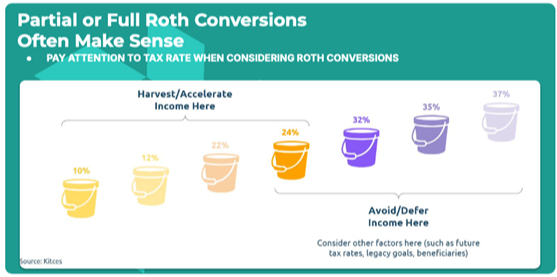
Over time, this “bracket-filling” strategy can yield significant savings. In the above hypothetical, by age 85, it could result in a $9.1 million tax-free value, compared to $8.2 million after taxes in a traditional IRA—a $885,376 advantage.
This hypothetical is for illustrative purposes only and not a guarantee of results. Actual outcomes depend on individual circumstances and market conditions. This information is for educational purposes only and does not constitute financial advice or a guarantee of future results. The hypothetical example of a $9.1 million tax-free value versus $8.2 million after taxes, resulting in a $885,376 advantage, is based on specific assumptions (e.g., tax rates, investment growth, and longevity) that may not apply to your individual circumstances. Performance and savings are not guaranteed, and actual outcomes may vary due to market conditions, tax law changes, and personal factors such as age, income, and investment choices. Consult a qualified financial advisor or tax professional to assess the suitability of Roth IRA conversions, especially at a 37% marginal tax bracket or for strategies involving undervalued assets, long-term tax control, or legacy goals. Past performance is not indicative of future results.
In summary, Roth conversions support proactive tax planning, helping you manage future liabilities, preserve wealth, and optimize retirement income. However, complexities like non-deductible IRA contributions require careful attention. A personalized analysis—considering tax brackets, age, income, RMDs, and market conditions—is crucial.
Consult a tax professional to understand the tax implications and avoid pitfalls. Our team is here to analyze your unique situation and explore options.
Protective Strategies - Protective Reserve and Essential Spending Approach
Have you ever wondered, "How much should I keep on hand in cash or savings?" We all have. Money is simply a means to an end—security, opportunity, and for some, freedom. While we can't control many aspects of our lives, there are protective strategies that can help protect us from acute distress and long-term adversity. We will discuss different types of protective strategies and how much you might want to set aside for your rainy-day fund.
What is considered acute distress? Acute distress occurs during adverse events that are short but have severe effects. For example, from 1929 to 1932 in the United States, equity markets collapsed, unemployment soared, and market liquidity dried up. Recent examples include the market crash followed by a recession in 2008 or COVID-19.
What qualifies as long-term adversity? It refers to adverse events that may not be very severe at first but last for a long time. For example, during the periods from 1932 to 1945 or 1973 to 1982, known as the Great Inflation, markets stabilized, yet unemployment remained high and economic growth stayed low. US equity markets took about 15 years to recover in real terms after the downturn of the 1930s. What can we do?
Protective Reserve and Essential Spending Approach
Protective Reserve Approach postpones the need to adjust spending during periods of acute distress. It is an emergency fund, lessening the impact of unexpected adverse events and providing "self-insurance" to offset unexpected expenses, such as health issues, property damage, legal costs, or job loss. High-quality nominal bonds are typically most appropriate for implementing a Protective Reserve, as such assets are least likely to lose value during periods of distress and perform well during a "flight-to-quality" or "flight-to-liquidity." However, nominal bonds are vulnerable to inflation surprises, reducing their effectiveness during unexpected inflation.
Essential Spending Approach protects a base level of essential spending against long-term adversity like unexpected inflation and economic downturns, such as a depression and stagflation. Typically, essential spending accounts for 40-50% of most families' budgets, covering basics and non-negotiable costs (essential): food, clothing, and shelter. The remaining portion is usually considered non-essential (important and discretionary) spending, representing about 60% of your budget, and can be funded with equities in retirement along an appropriate glide-path. High-quality inflation-protected bonds (TIPs) are generally most suitable for implementing an Essential Spending Approach.
Which strategy is best for your family, and how much should you consider?
The investment foundation of these strategies is high-quality, short-term bonds. Since the expected returns of bonds are low, use as few as possible and as many as necessary. The dollar amount needed depends on your spending habits and life priorities. Below, we’ll provide a few examples based on typical life stages (“learn it, earn it, burn it”).
Wealthy Household: An essential spending approach with a complementary 2-year protective reserve. An inflation-protected fixed income portfolio is matched dollar for dollar to cover the total essential spending needs for the rest of your life. The protective reserve enables spending and an additional self-insurance portfolio to handle unexpected emergencies or recessions.
Early career households have high spending flexibility and rely heavily on future earnings, making career development their most valuable financial asset. A 1.5-year protective reserve, disability, and life insurance (if children are present) help safeguard against income loss. Build a protective reserve first, then invest in risk assets.
Transitioning Household (approaching retirement), essential spending is NOT protected, and a 5-year protective reserve is necessary to cover core spending needs. This five-year reserve acts as a risk mitigation strategy against “sequence risk,” which involves poor investment returns or market downturns near retirement that can reduce your portfolio's value at the worst possible time.
Retired Household: Essential spending is protected, and a complementary 3-year protective reserve helps offset unexpected expenses, such as health-related expenses.
Wealth is often permanently destroyed when risk assets are sold at market bottoms during recessions or market corrections to meet immediate cash needs. Optimizing the "right" amount of cash and bonds as a protective strategy is a safety net, helping you weather acute and long-term financial storms by covering unexpected expenses and sustained challenges.
Click to schedule a call with the Harvester Wealth Team

Why TIPS Now: Real Yield and Hedge Against Inflation
The $37 trillion U.S. national debt pits the Federal Reserve’s 2% inflation target against the government’s efforts to lower interest rates to reduce the $952 billion interest expense on the 2025 deficit (source: CBO 2025-2035 Outlook). However, lower rates could reignite inflation above the Fed’s 2% goal. While high inflation erodes the real value of the $1.9 trillion deficit, making debt repayment easier (source: October 21, 2021, Can Higher Inflation Help Offset the Effects of Larger Government Debt? click link to read), it also reduces investors’ purchasing power by lowering real yields on nominal bonds. In short, lower rates with higher inflation benefit borrowers (the U.S. government) and harm savers (private investors). Sacrifices will be needed to decrease the national debt, and one of those might be accepting lower yields and higher inflation in the future.
This divergence between the Fed and policymakers makes Treasury Inflation-Protected Securities (TIPS) a key hedge against inflation uncertainty and a strong investment solution for the Essential Spending Approach.
What TIPS Are and How They Work
TIPS, launched by the US Treasury in 1997, are US government bonds designed to protect investors from the adverse effects of inflation for essentials such as food, clothing, and housing (click TreasuryDirect TIPS to learn more). TIPS, available in 5-, 10-, and 30-year terms, carry low credit risk and provide secondary market liquidity. TIPS principal rises with inflation (or falls with deflation) as measured by the CPI-U (source US BLS), with interest paid on the adjusted principal amount at a fixed rate every six months. The coupon payments are based on this adjusted principal; at maturity, you receive the greater of the adjusted or original principal. However, inflation adjustments are taxable annually (phantom income) and more suitable in tax-deferred accounts - IRAs, IRA rollovers, and non-taxable accounts - Roth IRA, and Roth IRA Rollovers.
As of June 25, 2025, the nominal 5-year Treasury yield was 3.86%, and the 5-year TIPS real yield was 1.55% (source: US Department of the Treasury, click link to track real yields). The TIPS real yield is the return above inflation paid to investors. The breakeven rate is a market-based measure of the average expected inflation over the next five years. On June 25, the 5-year breakeven rate was 2.28%, representing the difference between the yield on a nominal 5-year US Treasury note and the "real" yield of a 5-year Treasury Inflation-Protected Security (TIPS). Think of the breakeven rate as the "over/under" inflation forecasted and predicted by market participants and traders. In theory, if you expect inflation to be higher than the breakeven rate, you'd buy TIPS; if lower, you'd purchase nominal Treasuries. Breakeven rates can be tracked here at the Federal Reserve Bank of St Louis (FRED) Five-Year Break Even (inflation expectations).
TIPs vs. Nominal Bonds: Why Real Yields Matter
Consider the following hypothetical scenario, illustrating how “real” yields compare to nominal yields with the market expecting the inflation rate to average 2.28% over the next five years: what happens if actual or realized inflation averages 3%?
In that case:
- TIPs (Treasury Inflation-Protected Securities) return:
→ 1.55% real yield + 3% inflation = 4.55% approximate total return - Nominal bonds (fixed interest, no inflation protection):
→ Return is fixed at ~3.86%, regardless of actual inflation
Key Takeaway
- TIPS outperform nominal bonds when inflation is higher than expected
- They offer a better hedge against unexpected inflation shocks
Definitions
- Real Yield - The return on a bond after adjusting for inflation. It reflects how much your investment gains in purchasing power.
- Nominal Yield - The interest rate stated on a bond, not adjusted for inflation.
- TIPS - U.S. Treasury bonds that adjust the principal for inflation, protecting your real purchasing power
This example of a five-year TIPS real yield of 1.55% plus 3% inflation equaling a 4.55% return is for illustrative purposes only and does not guarantee future results. TIPS returns vary based on actual inflation rates, market conditions, and other economic factors. Investments carry risks, including potential loss of principal, and inflation may differ from assumptions. Consult a financial advisor to assess suitability for your financial situation.
TIPS and the Essential Spending Approach
TIPS are an excellent investment solution for funding an Essential Spending Protective Strategy.
- Protect 40–50% of a household’s annual budget—for example, $125,000 (essential) of a $250,000 (discretionary) annual budget.
- A $2.2 million TIPS portfolio could reliably fund essential expenses throughout retirement for a 60-year-old retiree with a 24-year life expectancy after accounting for the present value ($827,000) of their future Social Security benefits.
- TIPS are designed to withstand inflation shocks, including extreme periods like the 1970s' “Great Inflation” (1965–1982).
- If the real yield on TIPS is 1.55%, your return would be 1.55% above inflation, preserving purchasing power.
- In times of deflation, TIPS returns would decline in line with falling inflation (CPI-U), but essential expenses would likely fall too.
From 1926 to 2024, CPI has averaged 2.9% annually (Dimensional Matrix Book 2025). As of June 25, 2025, the portfolio would deliver a 1.55% Real Yield above inflation. We refer to this investment hedge as a Liability-driven Investment (LDI) portfolio. We can rely on high-confidence, inflation-protected TIPS to fund essential spending needs over a long period, even if we face surprise inflation or long-term economic adversity.
The information about Treasury Inflation-Protected Securities (TIPS) and Liability-Driven Investment (LDI) strategies is provided for informational purposes only. It does not constitute personalized investment advice or a recommendation by Harvester Wealth. Investing in TIPS involves risks, including interest rate risk, market volatility, and potential loss of principal, and past performance, such as during the 1965-1982 period, is not indicative of future results. Consult with Harvester Wealth to determine if these strategies are suitable for your financial goals and circumstances.
Conclusion
As we wrap up The Crop Report: Q3 2025, our goal is to share strategies that help protect and grow your wealth through any economic conditions ahead. We’ve discussed how rising income tax rates and inflation can reduce wealth and weaken purchasing power, and why proactive tax planning like Roth IRA conversions may help secure a more tax-efficient future. We’ve also explored the role of Protective Reserve Strategies, such as the Essential Spending Approach and TIPS, in safeguarding essential spending during volatility and uncertainty.
As farmers prepare for drought and bounty, smart financial planning involves planting the right seeds today. We are committed to helping you align your resources with your goals, so your harvest is plentiful when it matters most. If you’re interested in how these strategies could fit your financial plan, we invite you to schedule a call with our team.
